
What Makes Botanical Ingredients Effective in Haircare?
Botanical ingredients for hair can support conditioning, cleansing, scalp care, fragrance, antioxidant positioning, and sensory performance. However, a familiar plant name does not guarantee that a finished haircare product will deliver the expected benefits.
Plant species, growing conditions, extraction method, concentration, standardization, storage, packaging, and interactions with other ingredients can all affect performance. Evidence involving an isolated compound, essential oil, animal model, or therapeutic treatment also cannot be applied automatically to a commercial cosmetic.
Bayport Laboratories supports beauty brands developing botanical haircare products aligned with their ingredient strategies, performance goals, quality requirements, and production volumes. Successful development requires careful evaluation of botanical evidence, concentration, safety, stability, packaging, testing, and claims.
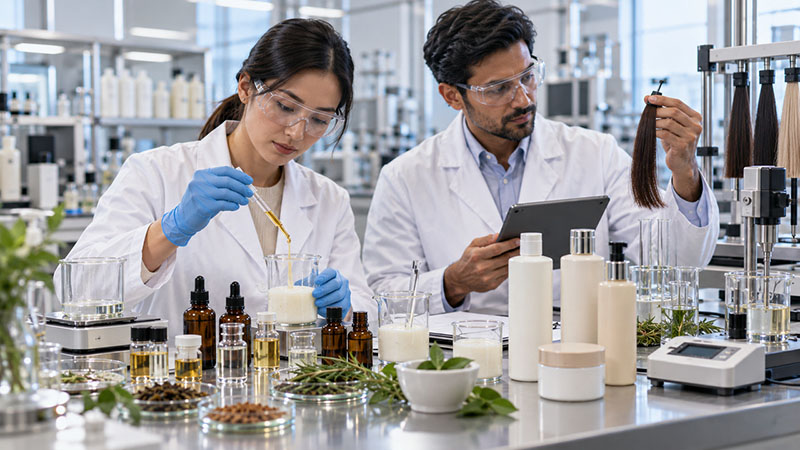
What Are Botanical Ingredients in Haircare?
Botanical ingredients are plant-derived materials used in shampoos, conditioners, masks, oils, scalp products, and styling formulas.
Common forms include:
- Plant extracts and hydrosols
- Essential and fixed oils
- Plant butters and waxes
- Gums, polysaccharides, and fermented materials
- Isolated plant compounds
Depending on the material, botanicals may contribute conditioning, lubrication, fragrance, color, antioxidant positioning, or scalp-care benefits. Different forms of the same plant are not interchangeable.
Separate Hair Growth Claims From Cosmetic Benefits
Many botanicals are marketed as ingredients that promote hair growth, prevent hair loss, or strengthen hair follicles. These claims require careful evaluation.
Hair growth involves the follicle and growth cycle. Most cosmetic benefits affect the visible hair shaft or scalp surface.
Appropriate cosmetic benefits may include:
- Improving softness and manageability
- Reducing friction and breakage
- Supporting shine
- Conditioning the scalp
- Improving the appearance of dry or damaged hair
- Helping hair look fuller or healthier
Reducing breakage may help hair retain visible length, but it does not prove that a product stimulates new growth.
In the United States, claims involving hair growth, hair-loss prevention, dandruff treatment, or effects on the body’s structure or function may cause a product to be regulated as a drug. Cosmetic claims must also be truthful and not misleading.
Evaluate the Strength of Botanical Evidence
Botanical evidence may come from:
- Cell or laboratory studies
- Animal research
- Isolated hair-follicle studies
- Small human studies
- Randomized controlled trials
- Systematic reviews
- Finished-product testing
These forms of evidence are not equivalent. Animal or cell findings may identify a possible mechanism, but they do not establish consumer performance.
Before using research to support a claim, ask:
- Was the study conducted in humans?
- Was the tested material the same extract or oil?
- Was the concentration comparable?
- Was the product rinsed off or left on?
- Was the study controlled?
- Does the evidence support the exact proposed claim?
The strongest substantiation connects relevant ingredient research with finished-product testing. The FDA also notes that companies may need additional testing when available safety data do not adequately address a cosmetic’s ingredients or intended use.
Botanical Ingredients With Relevant Haircare Evidence
Each botanical offers different formulation functions, evidence, and technical limitations. Selection should reflect the product format, intended cosmetic benefit, safety, stability, and compatibility.
Coconut oil
Coconut oil is one of the better-supported natural oils for direct hair-shaft benefits.
A comparative study found that coconut oil reduced protein loss from damaged and undamaged hair when used before and after washing. Mineral and sunflower oils did not show the same effect in that study.
Potential roles include:
- Pre-wash oils
- Hair masks
- Conditioners
- Leave-in products
- Breakage-reduction positioning
Formulation watchout: Coconut oil can create heaviness or buildup, particularly on fine hair. The study supports a hair-fiber benefit, not a claim that coconut oil stimulates healthy hair growth.
Rosemary oil
Rosemary oil is frequently used in scalp oils and serums associated with hair-growth positioning.
A small comparative trial found that rosemary oil and 2% minoxidil groups both experienced increased hair counts after six months. This does not establish that every rosemary product is equivalent to minoxidil.
Potential roles include:
- Scalp oils
- Leave-on serums
- Pre-shampoo products
- Fragrance and sensory positioning
Formulation watchout: The trial involved a specific preparation, population, application method, and duration. Its findings cannot be applied automatically to a rinse-off shampoo or a different rosemary extract.
Tea tree oil
Tea tree oil is used in scalp-cleansing products because of its reported antimicrobial and antifungal activity.
A randomized study found that a shampoo containing 5% tea tree oil improved measured dandruff outcomes compared with a placebo over four weeks.
Potential roles include:
- Scalp-cleansing shampoos
- Products for oily-feeling scalps
- Refreshing scalp products
- Fragrance
Formulation watchout: Tea tree oil may cause irritation or sensitization. The study involved a specific formula and does not prove that every tea tree product treats dandruff. Anti-dandruff positioning may also trigger drug requirements in the United States.
Peppermint oil
Peppermint oil is commonly used for cooling, refreshing, and invigorating sensory effects.
Research found increased follicle measurements after peppermint oil was tested topically in mice. This was an animal study, not a human clinical trial.
Potential roles include:
- Cooling scalp products
- Pre-shampoo oils
- Refreshing cleansers
- Fragrance
Formulation watchout: Peppermint oil should not be claimed to stimulate human hair follicles based on animal evidence. Menthol-related cooling may also become uncomfortable or irritating at unsuitable concentrations.
Ginseng and green tea
Ginseng contains ginsenosides studied in relation to dermal papilla cells and hair follicles. A review describes possible mechanisms involving ginseng and hair growth, but much of the evidence is laboratory or preclinical.
Green tea contains antioxidant polyphenols, including EGCG. Laboratory research has examined EGCG in cultured human hair follicles and dermal papilla cells.
Potential roles include:
- Antioxidant scalp products
- Shampoos and conditioners
- Scalp serums
- Botanical hair masks
Formulation watchout: Cell, animal, or isolated-follicle findings do not establish clinical hair-growth performance. Ginsenoside and polyphenol content can vary, while green tea compounds may be sensitive to light, heat, oxygen, and pH.
Saw palmetto
Saw palmetto is frequently marketed for its potential relationship to 5-alpha-reductase and dihydrotestosterone, or DHT.
A systematic review found promising but limited evidence involving saw palmetto and alopecia. The studies involved different preparations, concentrations, and routes of administration.
Potential roles include:
- Scalp serums
- Oils
- Leave-on products
- Products for thinning-looking hair
Formulation watchout: Claims that saw palmetto blocks DHT, prevents hair loss, or stimulates growth imply biological effects. They require appropriate regulatory review and product-specific evidence.F
Argan oil
Argan oil contains fatty acids and tocopherols and is commonly used for emollience, shine, lubrication, and sensory conditioning.
Potential roles include:
- Hair oils and serums
- Leave-in conditioners
- Hair masks
- Finishing products
A systematic review found stronger evidence for coconut oil’s hair benefits than for argan oil.
Formulation watchout: Argan oil may support lubrication and sensory performance, but claims involving damage repair, breakage prevention, or hair growth require finished-product evidence.
Aloe, amla, chamomile, and horsetail
These botanicals are frequently used in natural haircare, but their roles and evidence differ:
- Aloe vera: Used in lightweight conditioners, scalp gels, and shampoos for hydration or soothing positioning.
- Amla: Used in oils, masks, and conditioners associated with traditional haircare and antioxidant positioning.
- Chamomile: Used for fragrance, scalp comfort concepts, and products for light-colored hair.
- Horsetail: Marketed as a silica-containing botanical for stronger-looking hair.
Formulation watchout: Evidence that these materials stimulate growth or strengthen follicles in finished topical products is limited. Claims involving hydration, shine, breakage, or scalp comfort should be supported by relevant finished-product testing.
Distinguish Natural Oils From Essential Oils
Natural oils such as coconut, argan, jojoba, and sunflower oil consist mainly of lipids. They may provide emollience, lubrication, shine, and reduced friction.
Essential oils such as rosemary, peppermint, and tea tree are concentrated volatile materials associated with fragrance and biological activity.
Essential oils may introduce:
- Irritation or sensitization
- Strong fragrance
- Oxidation products
- Formula instability
- Packaging interactions
- Labeling considerations
A higher concentration is not automatically more beneficial. The appropriate use level depends on the material, formula, intended use, exposure, and safety assessment.
Formulation and Concentration Determine Performance
The botanical name on an ingredient list provides limited information about composition or performance.
Development teams should confirm:
- Latin name and plant part
- Ingredient form and extraction method
- Carrier or solvent
- Standardized compounds
- Proposed concentration
- Preservatives and antioxidants
- Allergen information
- Microbiological specifications
- Color and odor
- Storage requirements
- Supplier traceability
A rosemary essential oil, rosemary water, oil-soluble extract, and powdered rosemary are different materials. Evidence for one form may not apply to another.
The final concentration also matters. A botanical included at a low level for fragrance or marketing should not be presented as delivering the same result as a higher concentration tested in research.
Manage Stability, Safety, and Packaging
Botanical ingredients can introduce color, odor, oxidation, solubility, viscosity, microbial, preservation, and packaging challenges.
Development should evaluate:
- Essential-oil allergens and sensitization
- Botanical cross-reactivity
- Oxidation products
- Residual solvents
- Pesticides or heavy metals
- Microbiological quality
- Rinse-off versus leave-on exposure
- Light, air, heat, and moisture sensitivity
- Formula and packaging compatibility
Natural formulations still require appropriate preservation. Compatibility testing should use the intended formula and final packaging whenever possible. Describing a botanical as natural, soothing, or gentle does not guarantee consumer tolerance.
Test the Finished Botanical Haircare Product
Ingredient research is only one part of substantiation. Testing should reflect the finished formula, packaging, intended use, claims, and target market.
A testing plan may include:
- Stability testing
- Microbiological limits
- Preservative efficacy or challenge testing
- Packaging compatibility
- Physical and chemical specifications
- Consumer-perception testing
- Instrumental hair-fiber testing
- Combability or breakage evaluation
- Shine or smoothness assessment
- Scalp-tolerance testing
A breakage claim should use testing relevant to breakage. A shine claim should evaluate the finished formula’s effect on appearance. Research involving one ingredient cannot substitute for product-level evidence when the claim describes the complete formula.
The FDA emphasizes that natural origin does not guarantee safety and that manufacturers remain responsible for ensuring cosmetic products are safe under labeled or customary conditions of use.
Support Sustainability Claims With Evidence
Plant origin alone does not prove that an ingredient or product is environmentally preferable.
Brands should evaluate:
- Agricultural practices
- Water and land use
- Geographic sourcing
- Biodiversity effects
- Extraction methods
- Supplier labor practices
- Traceability
- Processing and shipping
- Packaging
- Waste and byproducts
Sustainability claims should be specific and supported by documentation. The FTC Green Guides caution marketers against broad, unqualified environmental claims that may mislead consumers.
Botanical Ingredient Evaluation Checklist
Before approving a botanical, confirm:
- Botanical identity and plant part
- Extract or oil type
- Supplier specifications
- Standardized compounds, when applicable
- Proposed concentration
- Safety and allergen information
- Regulatory status
- Evidence relevant to the intended benefit
- Formula compatibility
- Stability and preservation needs
- Packaging protection
- Sourcing documentation
- Claim-substantiation plan
The best ingredient is not necessarily the most recognizable botanical. It is the material that provides an appropriate, safe, stable, and supportable benefit in the intended formula.
Frequently Asked Questions
Possibly, but oils can affect foam, viscosity, clarity, fragrance, deposition, preservation, and stability. The formula may require solubilization, emulsification, or other technical adjustments.
Relevant documentation may include ingredient specifications, Certificates of Analysis, safety data, botanical identity, plant part, extraction method, carrier information, allergen statements, microbiological limits, contaminant testing, origin, storage requirements, and regulatory status.
Potentially. The replacement material may differ in composition, concentration, color, odor, preservatives, carrier, microbiological quality, or standardized compounds. A supplier change should undergo technical review and may require stability, compatibility, safety, or performance testing.
Brands should establish approved specifications and tolerances for the botanical and finished product. Supplier controls, standardized extracts, incoming-material inspection, reference samples, packaging protection, and appropriate storage can help manage variation.
It depends on the ingredient’s purpose, concentration, formula, target market, and proposed claim. An essential oil may contribute a noticeable scent even when added for another function, so “fragrance-free” positioning requires careful regulatory and consumer-interpretation review.
Botanicals should be listed using the ingredient names required or accepted in the target market. The declared name may need to identify the plant, plant part, and ingredient form. Brands should verify labeling requirements for every jurisdiction where the product will be sold.
Turn Botanical Ingredients Into Commercial Haircare Products
Effective botanical haircare requires more than selecting recognizable plant ingredients. Each formula must align ingredient evidence, concentration, safety, stability, packaging, and product claims with the intended consumer benefit.
Bayport Laboratories helps beauty brands develop botanical shampoos, conditioners, masks, oils, serums, styling products, and scalp-care formulas for commercial production.
References
Choi, B. Y. (2018). Hair-growth potential of ginseng and its major metabolites.
Evron, E., et al. (2020). Natural hair supplement: Friend or foe? Saw palmetto, a systematic review in alopecia.
Gavazzoni Dias, M. F. R., et al. (2022). Coconut, castor, and argan oil for hair in skin of color patients: A systematic review.
Kwon, O. S., et al. (2007). Human hair growth enhancement in vitro by green tea epigallocatechin-3-gallate.
Oh, J. Y., et al. (2014). Peppermint oil promotes hair growth without toxic signs.
Panahi, Y., et al. (2015). Rosemary oil vs minoxidil 2% for the treatment of androgenetic alopecia.
Rele, A. S., and Mohile, R. B. (2003). Effect of mineral oil, sunflower oil, and coconut oil on prevention of hair damage.
Satchell, A. C., et al. (2002). Treatment of dandruff with 5% tea tree oil shampoo.
U.S. Food and Drug Administration. (n.d.). Cosmetics Labeling Claims.
U.S. Food and Drug Administration. (n.d.). Product Testing of Cosmetics.